Layering and gases
|
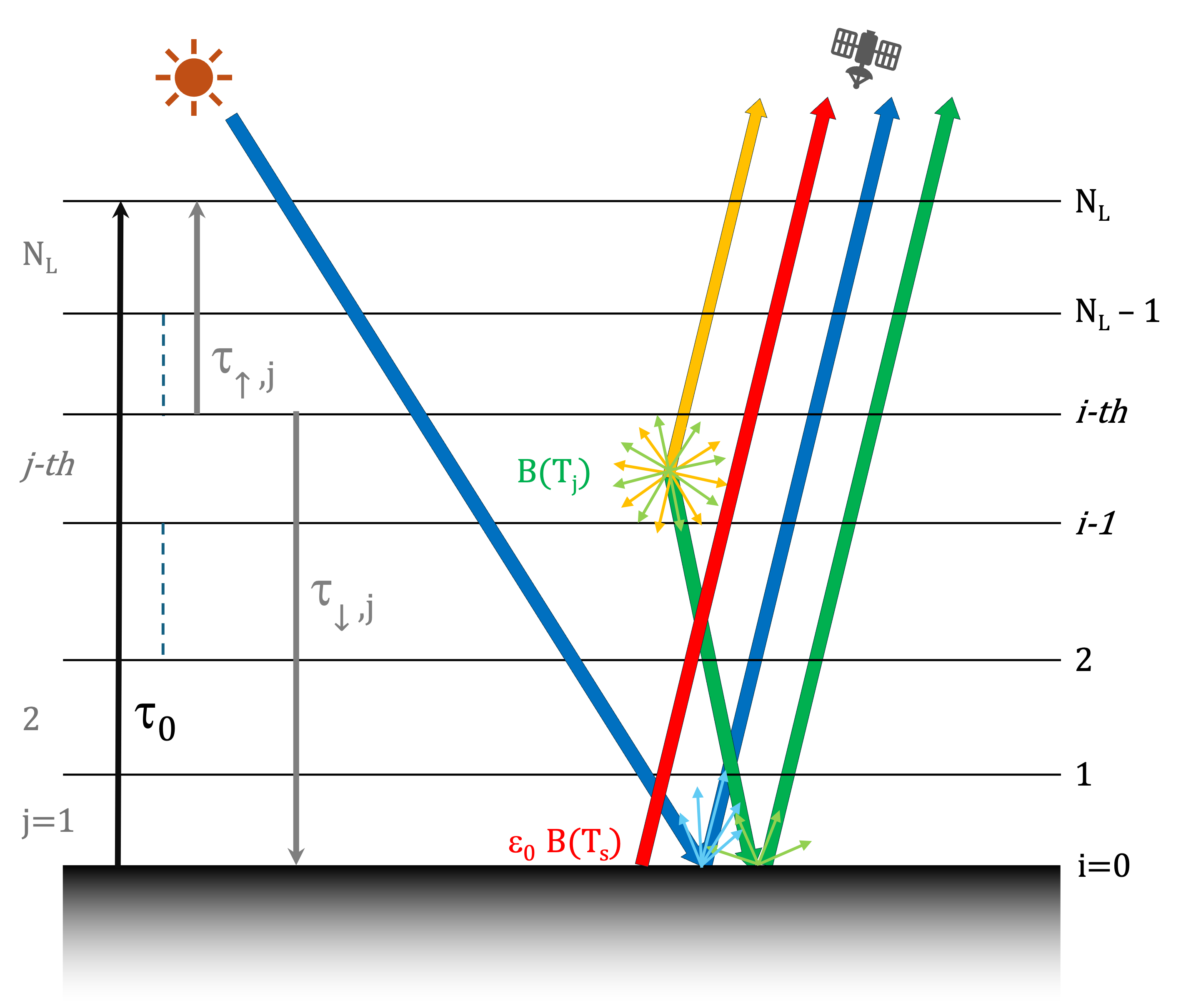
SIGMA solves the radiative transfer equation on a discretized atmosphere structured in 60 layers whose pressure boundaries (61) are fixed.
Each layer is considered homogeneous in temperature and composition. The basic ingredient in the radiative transfer equation is the
computation of transmittances, which ultimately is a function of the optical depth of gases and aerosols/clouds extinction efficiency.
While the radiative transfer equation needs the computation of cumulative transmittances from a certain altitude to the top/bottom of the
atmosphere, the code preliminarily computes single-layer transmittances and optical depths.
SIGMA computes the line component of gases
optical depths by including pre-computed look-up tables of polynomial coefficients, which parametrize optical depths as a second-order
polynomial of temperature. Given the i-th layer and j-th molecule, the optical depth at wavenumber σ, \(χ_{i,j}(σ)\),
is computed as follows:
\(χ_{i,j}(σ) = [c_{0,i,j}(σ) + c_{1,i,j}(σ)ΔT + c_{2,i,j}(σ)ΔT^2] q_{i,j}\)
with \( q_{i,j}\) being the mixing ratio of the j-th gas in the i-th layer and \(ΔT\) the difference between the i-th layer temperature
and a reference temperature at which the coefficients are computed and tabulated. The above expression is valid for all the gases except
H2O (j=1), which can be subject to significant variations in the atmosphere. Also, its maximum abundance in the troposphere is
high enough that self-broadening effects need to be accounted for in the polynomial parametrization, by adding a quadratic term in the water
vapor abundance:
\(χ_{i,1}(σ) = [c_{0,i,1}(σ) + c_{1,i,1}(σ)ΔT + c_{2,i,1}(σ)ΔT^2 + c_{3,i}(σ)Δq_{i,1}] q_{i,1}\)
where \( Δq_{i,1}\) is the difference between the i-th layer H2O abundance and a reference abundance at which the
coefficients are computed and tabulated.
At present, SIGMA look-up tables are computed initially at native "infinite" resolution with
the LBLRTM code, which is a line-by-line radiative transfer model widely used for Earth
science. Those look-up tables are then binned at two resolutions, 0.01 cm-1 and 0.1 cm-1, which are the two possible
resolutions at which SIGMA performs radiative transfer calculations internally. The look-up tables are computed using a reference atmosphere,
which is the AFGL U.S. Standard atmosphere, and varying the temperature by ±40 K. This approach, which is at the core of SIGMA
calculations, has been tested several times on real data and compared to LBLRTM and other line-by-line state-of-the-art models, and SIGMA
shows biases well below 0.05% in the whole spectral interval 10-3000 cm-1 in computed radiances.
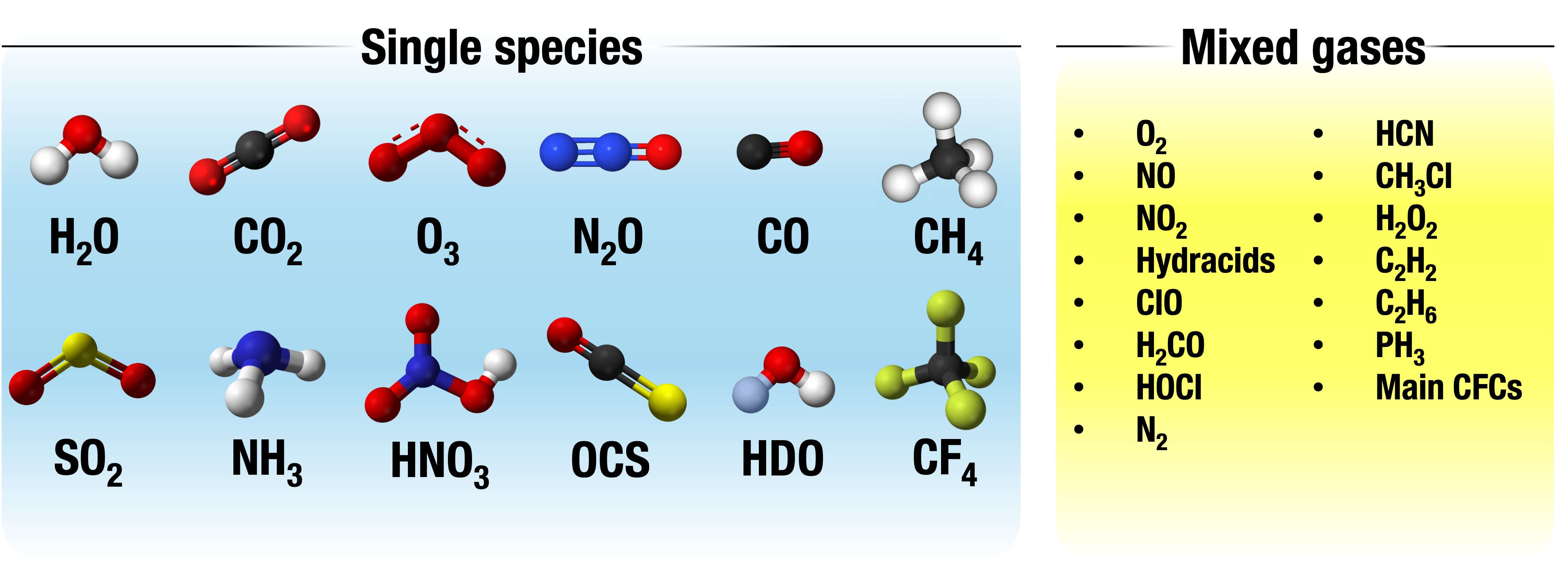
SIGMA includes coefficients
to simulate 12 variable gas species, which are listed here below. The other atmospheric species are parametrized all together as "mixed
gases" and include all species whose radiative impact in the TIR and FIR is small compared to the main species. Their concentration is
fixed to the U.S. Standard atmosphere, yet their optical depth is correctly scaled with the input atmospheric temperature.
|
Input atmosphere
The fact that the atmospheric layering is fixed in SIGMA implies that every calculation will be performed on this fixed layering.
Nevertheless, the user has an extra degree of freedom in the specification of the input atmosphere, as the model can ingest values of
pressure, temperature and abundances either on atmospheric levels, or on the set of 60 layers on which calculations are performed
internally by the model.
In the first case, the user is free to specify parameters on any pressure grid. After interpolating those
values on the 61 pressure levels embedded in SIGMA, the code will compute the average layer parameters assuming that each parameter
obeys to hydrostatic equilibrium and that, in a given layer, each parameter \(Y\) varies linearly with the logarithm of pressure:
|
\(Y_{average} = \frac{\int_{P_l}^{P_u} Y(p) dp}{P_l-P_u} \)
\(Y(P) = Y_u + (Y_l - Y_u) \frac{\log(P)-\log(P_u)}{\log(P_l)-\log(P_u)} \)
|
\( \xrightarrow{\text{exact solution}} Y_{average} = Y_u + \frac{Y_l - Y_u}{(\log(P_l)-\log(P_u))(P_l-P_u)}
[ P_l(\log(P_l)-1) - P_u(\log(P_u)-1) - \log(P_u)(P_l-P_u) ] \)
|
where \( Y_l\) and \( Y_u\) refers to the value of the quantity at the upper and lower boundaries of the considered
layer, and the same convention applies to pressure \( P\). SIGMA assumes the same functional form for all parameters (including particle
sizes). The possibility to input values at atmospheric levels instead of layers is very useful when using SIGMA solely for radiative transfer
purposes. When used in retrievals, instead, it is highly recommended to use SIGMA specifying directly layers' values, because retrievals
are typically finalized to find out the atmospheric parameters in terms of average value of each parameter in each layer.
|
The Linear in T approximation
When dealing with atmospheric layers that are very inhomogeneous, radiative transfer calculations can become more accurate by properly taking
into account such inhomogeneities. One of the most critical situations is when there is a strong thermal gradient between the two boundaries
and the layer is optically thick. Generally speaking, the integral expressing the atmosphere-emitted thermal radiation has an exact solution
according to the "integral average theorem":
\( \int_{z_{j-1}}^{z_j} B(T) \frac{\partial τ}{\partial z} dz = B(T(z^*)) (τ_j - τ_{j-1}) \),
with \( z_{j-1} \leq z^* \leq z_j \)
provided that \( \frac{\partial τ}{\partial z} \) does not change sign in the interval [\( z_{j-1}, z_{j}\)], which is generally true.
Other schemes, such as LBLRTM, use a more crude approximation, usually called "Linear in τ" approximation (e.g., see Rodgers 2000). In
this approximation, the integral above is calculated by considering that the Planck function B(T) is linear with the optical depth. The
advantage of the formulation in SIGMA is the analytical solution of the above integral. In a practical case, when SIGMA is used for
retrievals, \(T(z^*)\) is guessed equal to the layer's average temperature, and its final value is that which best fits the spectral
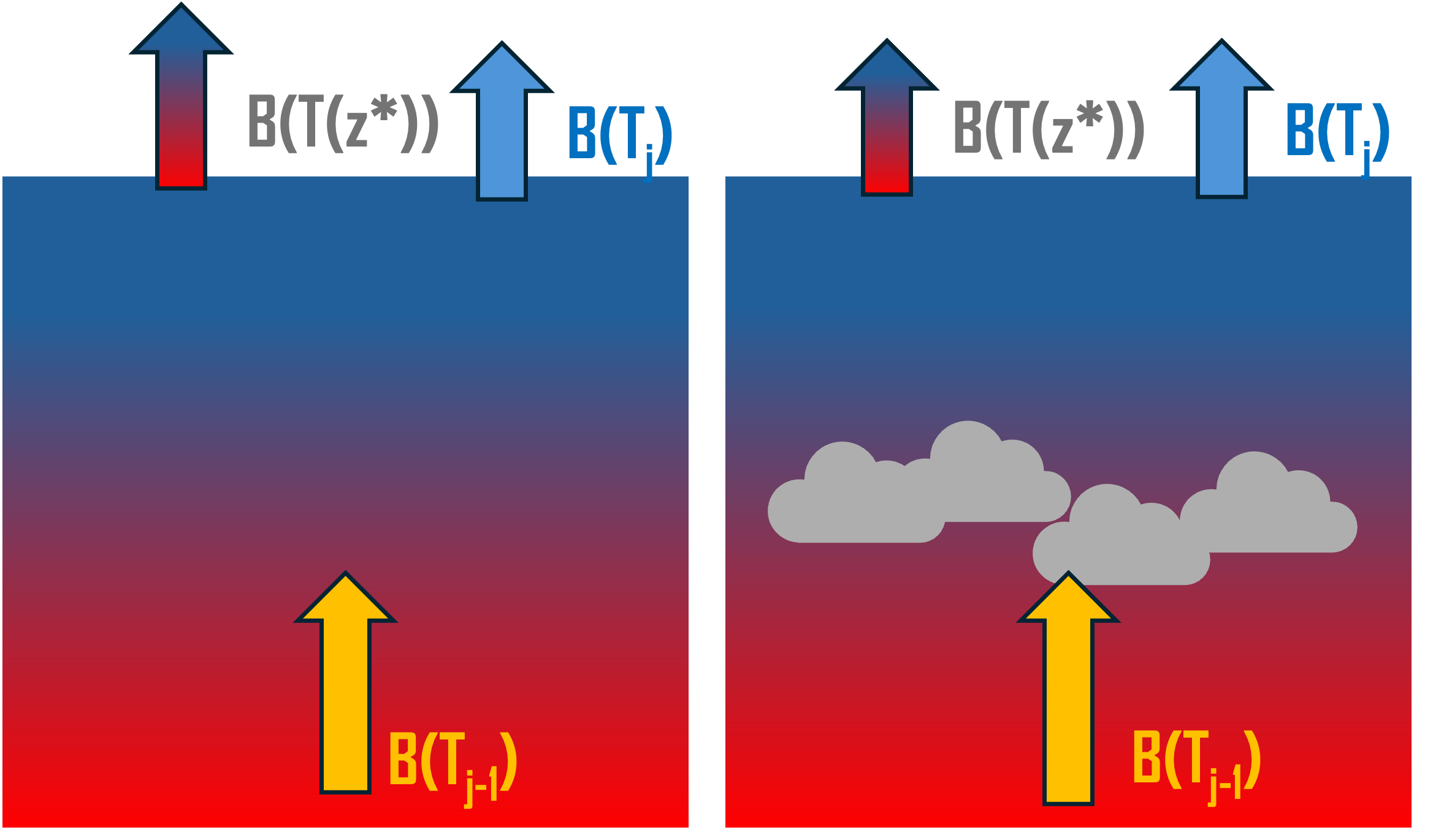
radiances. Yet, this can still be a too-crude approximation, especially for cloudy skies, which in the limit of overcast conditions, where
the given j-th layer is opaque to the radiation coming from below, and the emitting temperature becomes that of the layer top. This is the
case where SIGMA can be used activating what is named here the "Linear in T" approximation, which relies on the assumption that:
|
\( B(T(z^*)) = \frac{\int_{z_{j-1}}^{z_j} B(T) \frac{\partial τ}{\partial z} dz}{\int_{z_{j-1}}^{z_j}
\frac{\partial τ}{\partial z} dz} \approx \frac{τ_j B(T_j) + τ_{j-1} B(T_{j-1})}{τ_j+τ_{j-1}} \)
|
|
which is the Planck function at the endpoints of the interval [\(z_{j-1}\), \(z_{j}\)] weighted with the transmittance at the same endpoints.
By considering the definition of transmittance, this can be cast in a more straightforward and immediate form:
\( B(T(z^*)) = \frac{B(T_j) + \exp(-χ_j) B(T_{j-1})}{1 + \exp(-χ_j)} \)
In this way, when the optical depth of the layer tends to zero, the equivalent blackbody radiation coming from the layer will be the average
of the blackbodies of the two layer boundaries. Conversely, when the optical depth is very high, the equivalent blackbody radiation will be
the one from the upper boundary. SIGMA allows for the use of this approximation at user's discretion, and it can be used either in clear or
cloudy sky scenes.
|
Continuum absorption
Besides line absorption, some gases in the Earth atmosphere yield an additional absorption contribution which is much more spectrally
smooth than line absorption. For the most, this additional absorption can be explained by collisional effects, in which inelastic molecular
collisions have a certain probability to activating specific absorption modes. Additionally, in the specific case of water vapor, the
almost ubiquitous presence of spectral lines makes it difficult for line-by-line codes to account for the full line absorption, as such
codes compute line shapes within ±25 cm-1 the line center. This underestimates the total line absorption especially in the
core of roto-vibrational bands, and implies the need to introducing a non-parametric, additional continuum absorption term in the radiative
transfer.
SIGMA includes all of these contributions, for the following specific collisional pairs: N2-N2,
N2-O2 and O2-O2, which are the most common in Earth's atmosphere and are significant in the
IR region. These absorptions are treated with the formalism of Collision-Induced Absorptions (CIAs)
as seen in the HITRAN molecular spectroscopy database. The water vapor continuum is also treated with the
very same formalism of the CIAs, despite its origin which is, overall, different. However, on the basis of the work done in
Kofman & Villanueva (2021), it is easy to use the same mathematical formalism of
the CIAs to treat water self and foreign continuum.
Calculations in SIGMA are performed with look-up tables of CIAs cross-sections at
various temperatures, and with equivalent cross-sections for water self and foreign continua. This allows for calculations that are much
more traceable than those in LBLRTM, and a code that is easy to maintain and update, instead of the rigid and cryptic LBLRTM contnm routine.
|